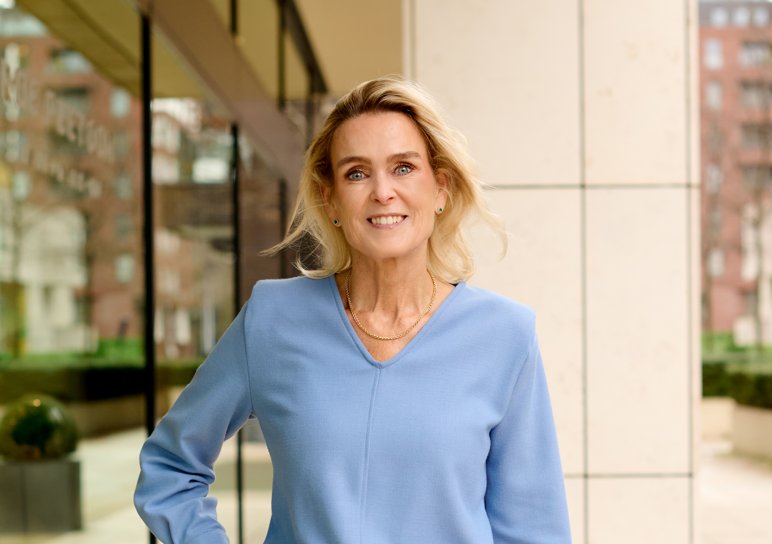
“ECONOMICS IS ABOUT WELFARE AND WELLBEING, NOT PROFIT”
Barbara Baarsma, chief economist at PwC Netherlands and
professor of applied economics at the University of Amsterdam (UvA)
Barbara Baarsma is chief economist at PwC Netherlands and professor of applied
economics at the University of Amsterdam (UvA). She also holds several public
posts, including Bank Council chair of De Nederlandsche Bank (Dutch Central
Bank) and member of the Nederlands Comité voor Ondernemerschap (Netherlands Committee for Entrepreneurship). From her office just a stone’s throw from Zuidas, she applies a broad economic and social lens to issues such as productivity, diversity and women’s position in the labour market. “Economics isn’t about maximising profits,” she says, “but about maximising prosperity: wellbeing, life satisfaction and quality of life.”
Who is Barbara Baarsma and how would you describe yourself outside all of your titles?
“I’m an economist, first and foremost. To me, economics is fascinating science, because it’s about making choices in a world of scarcity. Take the Zuidas, where we are now. You might assume everything here revolves around maximising profits. But that’s not what economics is truly about. Economics is about creating the greatest possible prosperity for the largest number of people. By prosperity I don’t just mean income, I’m referring to wellbeing, life satisfaction and opportunities for personal growth. This is what I dedicate my time to: in academia, at PwC and in my other roles.”
You regularly speak about the position of women in business. What do you see as the biggest impediment to women’s advancement to leadership roles?
“One of the main factors is the stage at which people choose to have children. In the Netherlands, women are far more likely than men – far more than in other countries – to switch to part-time work. This often happens immediately after graduation, even before children arrive. This result is not only a wage gap but also a promotion gap. Because men tend to keep working full time or nearly full time, they advance more quickly. I always tell my students and young colleagues: think carefully about your own timeline and motivations. If you have a partner you want to grow old with and you’re both ready, don’t wait for the perfect house or the perfect salary. Let your career and your family grow side by side, and build in some flexibility. You’re more likely to need that flexibility at the start of your family and career than halfway through.”
Working from home has been normalised since Covid-19. Is this good news for our work-life balance, or a risk?
“During Covid-19, working from home was often mandatory. But to young people who still have so much to learn, I always say: don’t work from home too much. You learn the most from chance interactions – looking over a colleague’s shoulder, casual conversations at the coffee corner – not just from efficient Teams meetings. Moreover, many jobs simply can’t be done remotely: roles in healthcare, hospitality and a wide range of service jobs. Not everyone has the privilege of hybrid working. But, for those who do, the keyword is: intentionality. Be present when learning, brainstorming, and decision-making happen, especially if you’re ambitious and want to move up.”
You’ve been critical of the quota for women in leadership positions. Why do you believe it’s not effective enough?
“Let me start by saying that I fully support diverse teams. However, the current phased quota applies only to the top level - the management boards and supervisory boards of listed companies – so it doesn’t address the real issue. First, I find it problematic that the government is compelling companies, turning diversity in a ‘must’ rather than a ‘want’. Real cultural change is driven by intrinsic motivation. Second, the quota does nothing for the layer below – the senior management – which is the talent pool for the top-level positions. If many women drop out at that stage, for instance because they start working part time after having children, the pool remains small. Third, quotas can create situations where women are perceived as token appointments, leaving doubts about whether they’re there for their capabilities or simply to tick a box. That’s unfair and unnecessary. Policy should focus far more on expanding the talent pool and creating conditions that enable both women and men to pursue careers aligned with their talents and ambitions. Finally, diversity is much broader than gender, and quotas do nothing to address cultural diversity, for example.”
Which leadership qualities in women do you think remain undervalued?
“I believe it’s risky to divide leadership too rigidly into male and female categories. Diversity encompasses far more –education, cultural background, age, character. That said, research does reveal some trends. On average, women tend to be slightly less competitive, take a longer term perspective and approach risk differently. Not that they’re more risk-averse – that would be too judgemental – but rather more risk-aware. Women also often adopt a broader stakeholder perspective, considering not only shareholders but also employees, customers, suppliers and the wider community. These qualities are immensely valuable in an era defined by sustainability and AI. Another crucial trait for both men and women is the ability to embrace doubt. Doubt is sometimes seen as a weakness, yet in my academic work I’ve learned how empowering it can be to continually question your own assumptions. A leader who can say ‘I’m not sure’ creates space for others to contribute and enables better decisionmaking – ultimately strengthening teams.”
What’s your number one career lesson for ambitious professionals in Zuidas?
“I once turned down an interesting job after asking one critical question: How much time and mandate will I actually have to work on the organisation’s future? Today, many companies are focused on the basics in order – lowering costs, upgrading outdated IT systems, clearing compliance backlogs. That’s important work, and there are people who excel at it. But my expertise lies in shaping the future and driving transformation. When I realized I’d be spending 95 per cent of my time on ‘getting the basics in order’, I said no thanks. My advice: start with what truly motivates you. What impact do you want to make? How will this step in your career help you reach not ‘the top’ in an abstract sense, but ‘your top’ – a place where your talents shine? Ask questions that dig deep into this, and don’t stop until you have an honest picture.”
What role do you envisage Zuidas playing in the wider Dutch economy and society?
“An extraordinary concentration of knowledge exists in the Zuidas, supported by a powerful ecosystem of major consultancies, banks and law firms as well as knowledge institutions like the universities. The Dutch economy is facing multiple constraints. If we want to maintain our broad prosperity, including high levels of happiness and life satisfaction, then we must become more productive and innovative. The knowledge and creativity concentrated in Zuidas are essential to achieving that. Everyone working here should feel they are contributing to more than just their organisation’s bottom line. Zuidas is a knowledge-intensive hub and by continuing to invest, conduct research and consider not only shareholders but all stakeholders – including those at the foundation of our labour market – it can serve as a source of renewal and social stability. If we fully harness this strength, we can finally tackle what has always been the holy grail of my work: maximising prosperity for as many people as possible.”